 English
 Deutsch
 Polski
LukyDeluxe Audio Lab
StringLoom
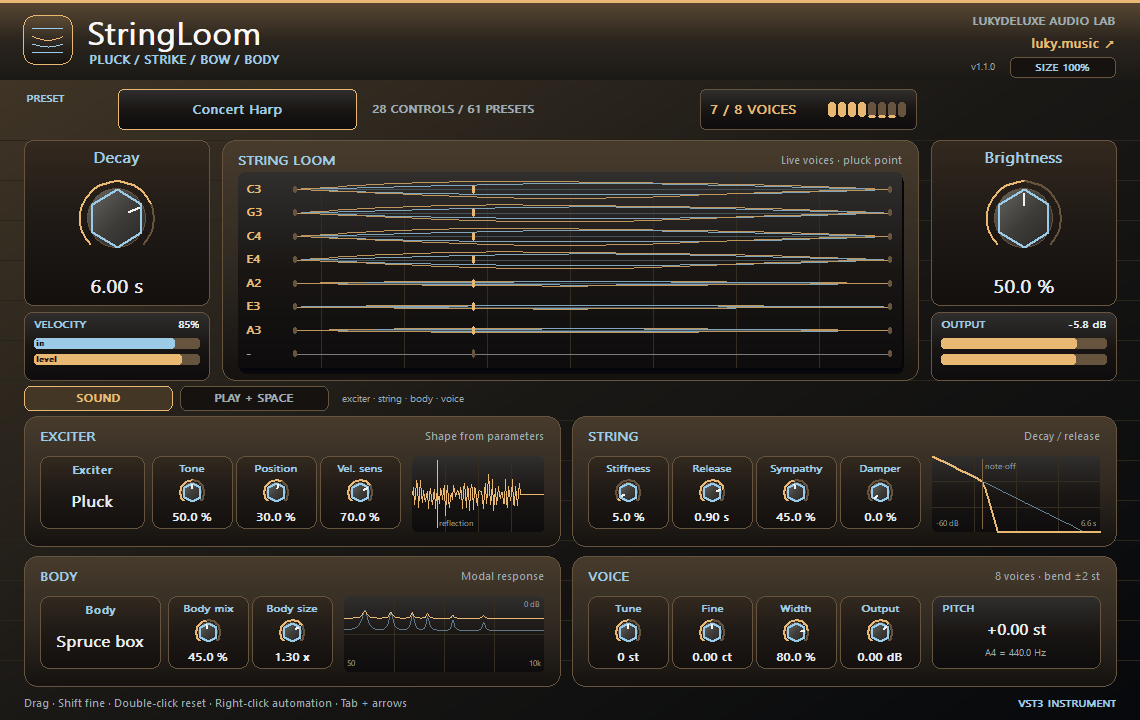
Physically modeled strings with eight voices. Choose pluck, pick, hammer or bowed noise and one of five resonant bodies; version 1.1 adds six resonance strings, vibrato, strum and its own room.
How it works
StringLoom calculates every note as a vibrating string. The exciter sets it in motion: Pluck, Pick, Hammer or Bow noise. Position sets the plucking point, Brightness and Stiffness shape the overtones and inharmonicity, and Decay sets the ring time from 0.2 to 20 seconds. Tuning holds throughout: in testing, pitch between notes 28 and 100 at 44.1 kHz deviated by at most 0.013 cents. Bow attack lets bowed notes fade in over 10 ms to 1 s, and Variation gives each note a slightly different tuning, decay and brightness.
Sympathy lets related partials of other sounding strings ring along. New are six dedicated resonance strings, tuned with Resonance key and excited by the strings you play. A shared body then shapes the sound: Spruce box, Bamboo tube, Clay gourd, Glass bowl or Steel plate, with Body mix and Body size. Space adds a compact stereo room after it.
For playing, Strum spreads simultaneous notes over up to 80 ms. Damper mutes released strings like felt, and Vibrato adds up to 50 cents at 2 to 9 Hz. The mod wheel controls Vibrato, Brightness, Bow pressure or Body mix, and the bend range goes up to 12 semitones. The new PLAY + SPACE page shows the live spectrum with the ideal overtones of the latest note. 28 parameters and 61 presets in eleven groups, from Harp and Mallet to Cinematic and Lo-Fi.
Features
- Four exciters: Pluck, Pick, Hammer and Bow noise, bow attack 10 ms to 1 s
- Eight voices, 0.2–20 s decay, 0.02–3 s release, damper and sustain pedal
- Five body models, six resonance strings with their own key and a stereo room
- Strum, variation, vibrato, mod wheel targets and 0–12 semitone bend range
- Live spectrum, 28 automatable parameters and 61 presets
Ways to use it
- Plucked hook over a pop or house beat
- Slowly swelling bowed texture for a quiet film intro
- Strummed chords with resonance strings in an ambient track
Try it
- Load Glass Strings and play a chord.
- Raise Strum to about 20 ms, set Resonance key to the key of your song and turn up Resonance.
- Switch Body to Clay gourd, set the mod wheel to Vibrato and watch the spectrum on PLAY + SPACE.
Controls
Four exciters, five bodies, six resonance strings, strum, vibrato and space
Compatibility and notes
Free VST3 instrument for a MIDI track, latency 0. Exciter and Position only affect new notes. Above roughly one eighth of the sample rate (around note 112 at 44.1 kHz) pitch is capped, and Stiffness is reduced automatically on very high notes. From the ninth note on, a new note takes over a voice with a 4 ms delay. Sympathy only works between sounding voices; the six resonance strings follow Resonance key, not the chords you play. Projects from version 1.0.0 sound unchanged, and the new functions start neutral. Version 1.1.0 as VST3 for Windows x64, macOS Universal (arm64/x86_64) and Linux x86_64. The Mac edition is not notarized. No AU and no standalone application. Checked with pluginval at strictness 10 on Windows, macOS and Linux, plus REAPER 7.86 smoke tests on macOS (Apple Silicon) and Linux. All parameters support DAW automation; right-click opens the host's parameter menu where the host supports it.
Windows x64 and macOS Universal (Apple Silicon/Intel). The Mac edition is not notarized. Intel runtime testing is not documented; follow the host and installation notes for the individual download.
All sound knobs, switches and selection parameters support host automation. Right-click a parameter to open its menu where your DAW provides one.
Install
- Choose the ZIP for your operating system and extract it.
- Windows: copy the entire .vst3 bundle to C:\Program Files\Common Files\VST3.
- macOS: extract the ZIP and open the product .pkg in the Installer folder. Install for your current user. The Mac edition is not notarized; follow the Mac installation and security guide on this page.
- Linux x86_64: copy the complete .vst3 bundle from Plugin to ~/.vst3/ (create the directory if needed). The editor uses X11 via Cairo/XCB and requires a VST3 host with IRunLoop; Wayland requires XWayland. Native Wayland and Linux ARM64 are not supported. Built on Ubuntu 22.04; checked with pluginval (including the real-time check) and in native test hosts under Xvfb. A test in a Linux DAW is still pending.
- Rescan plugins in your 64-bit VST3 host. Load instruments on a MIDI track and effects in an audio insert.
Download details
- Windows x64 · VST3
- LukyDeluxe-stringloom-1.1.0-windows-x64-17bd81c1d439.zip
- ZIP size
- 0.53 MiB
- SHA-256
- 17bd81c1d439cfac6692a292eddab951d8d1323025d5dd8f60a8b55752532357
- macOS Universal · VST3
- LukyDeluxe-stringloom-1.1.0-macos-universal-1e940108aedc.zip
- ZIP size
- 0.52 MiB
- SHA-256
- 1e940108aedc4e780e0372735dde9f436244377d17f42df063da820ba170933e
- Linux x86_64 · VST3
- LukyDeluxe-stringloom-1.1.0-linux-x86_64-907b93c0e0bf.zip
- ZIP size
- 0.35 MiB
- SHA-256
- 907b93c0e0bf256b7910a7d41c3037bfcca432dbf97caab18532d3c4f28c714d
Mac installation, step by step
The Mac edition of StringLoom is not notarized by Apple. Its ZIP contains an installer for this specific plugin. Load the installed VST3 in a 64-bit DAW that supports VST3; it is not a standalone app.
1. Extract the ZIP and open the installer
- Choose the macOS Universal ZIP. Quit your DAW and extract the complete ZIP in Finder.
- In the extracted Installer folder, open stringloom.pkg for StringLoom. Do not launch the .vst3 as an app.
- If macOS blocks the installer because of an unidentified developer or missing Apple checks, follow section 2. Then reopen that same .pkg file.
- In Installer, choose installation for your current user account or home folder and finish the installation. The plugin destination is shown below.
- Restart your DAW, rescan its VST3 plugins and load StringLoom there. Instruments use a MIDI track; effects use an audio insert.
Installation destination for your Mac user account
~/Library/Audio/Plug-Ins/VST3/
2. If macOS blocks the installer
Consider this exception only if you downloaded the file yourself from luky.music and trust that specific file. It applies to the product .pkg, not the .vst3 bundle.
- First try to open stringloom.pkg. Dismiss the unidentified-developer or missing-Apple-check alert, for example with Done; wording varies by macOS version.
- Open System Settings → Privacy & Security and scroll down to Security. Find the recently blocked entry with the actual filename of this product .pkg.
- If Open Anyway is offered for that exact installer, select it and confirm any further opening request. Approve any Mac password or Touch ID request yourself, only in the macOS system dialog.
- Reopen the same .pkg if Installer does not appear automatically. Install only for your current user. Then restart the DAW and rescan the plugin.
No matching entry, or a different warning?
If the entry for the recently blocked .pkg remains absent, contact our support or your IT administrator on a managed Mac. If approving the .vst3 bundle only opens Finder and the DAW remains blocked, the plugin has not been successfully approved; use the product installer. Do not use this procedure to dismiss warnings about malware or a damaged or modified file: stop installation and investigate. Filenames and checksums are listed under Download details.
Keep Gatekeeper enabled. This guide requires neither Terminal commands to remove quarantine nor blanket approval for other software.
Apple’s guidance for safely opening downloaded software ↗