 English
 Deutsch
 Polski
LukyDeluxe Audio Lab
OwnObject
A free eight-voice instrument combining the original attack and analysed resonances of a WAV for MIDI performance.
How it works
A short impact, a ringing object or a sound you designed can become the starting point for a personal instrument. OwnObject analyses a WAV and combines its retained original attack with up to 24 resonances and their decay behaviour. Play the result with eight MIDI voices; note 60 preserves the original object's tuning.
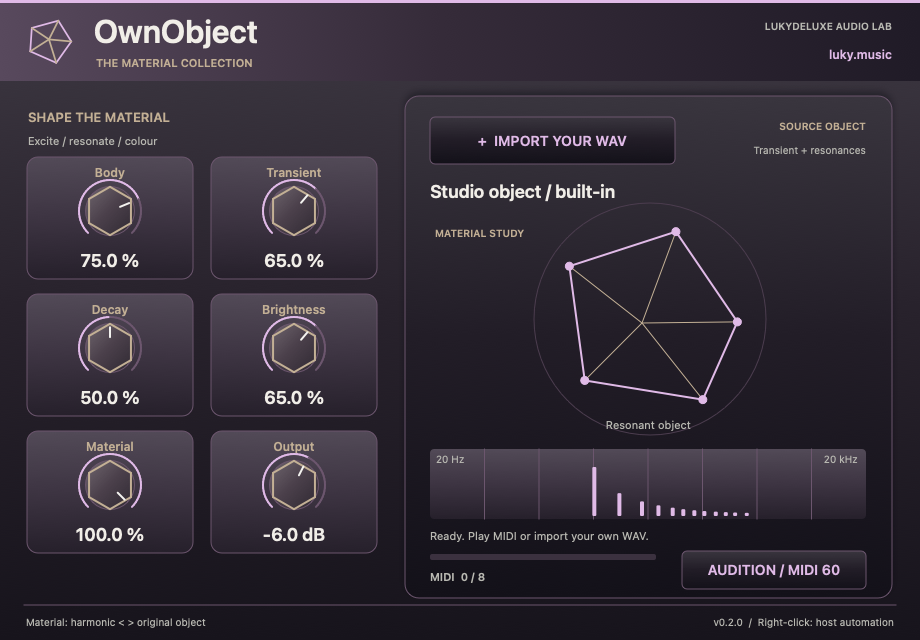
Body and Transient balance the resonant body against the attack. Decay and Brightness shape length and tone, while Material moves resonance spacing between a harmonic approximation and the analysed, often inharmonic ratios. Build individual mallets, plucks and tuned percussion from your own material. The supplied glass-, wood- and metal-like examples are mathematically synthesized sounds, not recordings of real objects. A physical dial group occupies two columns and three rows on the left; WAV import, a graphic material study and stored resonances sit on the right. Violet gradients and the original object mark connect the view.
Features
- Eight-voice MIDI instrument with original attack and up to 24 analysed resonances
- WAV import with the analysed object embedded in project state
- Body, Transient, Decay, Brightness, Material and Output
- MIDI note 60 retains object tuning; transposition also changes attack playback speed
- Playable synthesized starting object and Audition function
- Original synthesized examples with glass, wood and metal character
- Native macOS editor with parameter automation and host context menus
- A physical dial group occupies two columns and three rows on the left; WAV import, a graphic material study and stored resonances sit on the right. Violet gradients and the original object mark connect the view.
Ways to use it
- Personal mallet and pluck instruments from short sounds
- Tuned object percussion for EDM and scoring
- Sound design using distinct attacks and inharmonic resonances
Try it
- Load OwnObject on an instrument track and import a short WAV with a clear attack or interesting resonance.
- Play MIDI note 60 for the original object tuning; FL Studio commonly labels that note C5.
- Balance Body and Transient, then shape Decay, Brightness and Material.
- Start with Output at −6 dB and save the embedded object in your DAW project.
Controls
Load WAV · Body · Transient · Decay · Brightness · Material · Output
Compatibility and notes
Import: mono/stereo WAV, PCM 16/24/32-bit or float32, 8–384 kHz, up to 32 MB and at least 256 samples. Analysis uses the first four seconds; the attack retains up to 8,192 samples after internal preparation at 48 kHz. No automatic concert-pitch tuning, MPE or complete physical material reconstruction. Early Access by LukyDeluxe Audio Lab, version 0.2.0 as VST3 for Windows x64 and macOS Universal (arm64/x86_64). The Mac edition is not notarized. No AU or standalone application. Broad DAW, GUI and long-session compatibility is still being developed. All sound parameters support DAW automation. Right-click opens the host-supplied parameter menu where the host supports this feature.
Windows x64 and macOS Universal (Apple Silicon/Intel). The Mac edition is not notarized. Intel runtime testing is not documented; follow the host and installation notes for the individual download.
All sound knobs, switches and selection parameters support host automation. Right-click a parameter to open its menu where your DAW provides one.
Install
- Choose the ZIP for your operating system and extract it.
- Windows: copy the entire .vst3 bundle to C:\Program Files\Common Files\VST3.
- macOS: extract the ZIP and open the product .pkg in the Installer folder. Install for your current user. The Mac edition is not notarized; follow the Mac installation and security guide on this page.
- Linux x86_64: copy the complete .vst3 bundle from Plugin to ~/.vst3/ (create the directory if needed). The editor uses X11 via Cairo/XCB and requires a VST3 host with IRunLoop; Wayland requires XWayland and a compatible host. Native Wayland and Linux ARM64 are not supported. Built on Ubuntu 22.04; exact library requirements are in INSTALL.txt in the Linux ZIP. Checked in native test hosts/Xvfb and pluginval; not yet tested in a Linux DAW. Not every Linux host or distribution has been tested. OwnObject WAV import additionally requires Zenity (zenity).
- Rescan plugins in your 64-bit VST3 host. Load instruments on a MIDI track and effects in an audio insert.
Download details
- Windows x64 · VST3
- LukyDeluxe-ownobject-0.2.0-windows-x64-c7362c3d7098.zip
- ZIP size
- 0.52 MiB
- SHA-256
- c7362c3d7098db1d4db9c73aa8073e775e4136699f2c1c982c0a0d8e6bbffe66
- macOS Universal · VST3
- LukyDeluxe-ownobject-0.2.0-macos-universal-0e0e78e70006.zip
- ZIP size
- 0.15 MiB
- SHA-256
- 0e0e78e70006457e0a1d1f2a09e8e1ca7b10ac8d079433c8a98cdc4f115d315f
- Linux x86_64 · VST3
- LukyDeluxe-ownobject-0.2.0-linux-x86_64-5d1b577899ae.zip
- ZIP size
- 0.10 MiB
- SHA-256
- 5d1b577899ae407bc312389db64ec80828f6ac44c0235ce31c1f7c79a7fc55d8
Mac installation, step by step
The Mac edition of OwnObject is not notarized by Apple. Its ZIP contains an installer for this specific plugin. Load the installed VST3 in a 64-bit DAW that supports VST3; it is not a standalone app.
1. Extract the ZIP and open the installer
- Choose the macOS Universal ZIP. Quit your DAW and extract the complete ZIP in Finder.
- In the extracted Installer folder, open ownobject.pkg for OwnObject. Do not launch the .vst3 as an app.
- If macOS blocks the installer because of an unidentified developer or missing Apple checks, follow section 2. Then reopen that same .pkg file.
- In Installer, choose installation for your current user account or home folder and finish the installation. The plugin destination is shown below.
- Restart your DAW, rescan its VST3 plugins and load OwnObject there. Instruments use a MIDI track; effects use an audio insert.
Installation destination for your Mac user account
~/Library/Audio/Plug-Ins/VST3/
2. If macOS blocks the installer
Consider this exception only if you downloaded the file yourself from luky.music and trust that specific file. It applies to the product .pkg, not the .vst3 bundle.
- First try to open ownobject.pkg. Dismiss the unidentified-developer or missing-Apple-check alert, for example with Done; wording varies by macOS version.
- Open System Settings → Privacy & Security and scroll down to Security. Find the recently blocked entry with the actual filename of this product .pkg.
- If Open Anyway is offered for that exact installer, select it and confirm any further opening request. Approve any Mac password or Touch ID request yourself, only in the macOS system dialog.
- Reopen the same .pkg if Installer does not appear automatically. Install only for your current user. Then restart the DAW and rescan the plugin.
No matching entry, or a different warning?
If the entry for the recently blocked .pkg remains absent, contact our support or your IT administrator on a managed Mac. If approving the .vst3 bundle only opens Finder and the DAW remains blocked, the plugin has not been successfully approved; use the product installer. Do not use this procedure to dismiss warnings about malware or a damaged or modified file: stop installation and investigate. Filenames and checksums are listed under Download details.
Keep Gatekeeper enabled. This guide requires neither Terminal commands to remove quarantine nor blanket approval for other software.
Apple’s guidance for safely opening downloaded software ↗