 English
 Deutsch
 Polski
LukyDeluxe Audio Lab
SubAnchor
A free mid/side tool with independent bass/upper widths and an optional manually tuned sub tone.
How it works
SubAnchor controls bass stereo width separately from the frequencies above it. Choose the crossover, reduce the low side contribution and retain more width higher up if desired. Independent Mid, Side, Bass and Upper gains plus Side Rumble Cut help shape the balance. Bass Drive adds a separate colour stage to the low mid signal.
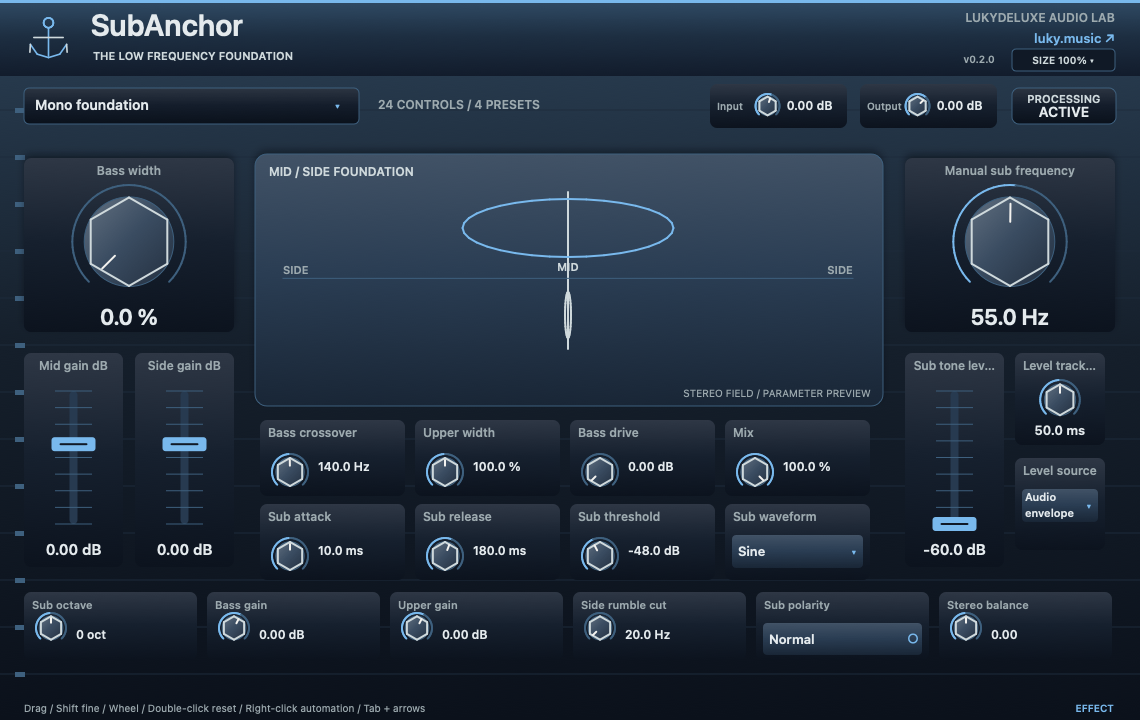
An optional centred oscillator can add a deliberately tuned sub tone. Set its frequency and octave manually, with Sine, Soft Triangle and Sine + Octave shapes available. Its level can follow the low input signal or MIDI gate and velocity. Attack, Release, Threshold and Polarity adapt it to the track. The added oscillator stays silent while Sub Tone Level is at its minimum. The mid/side field preview sits between bass-width, sub-frequency and level controls. All 24 parameters are arranged in one overview; steel-blue gradients and the anchor mark give the bass tool its own shape. The graphic is a parameter preview.
Features
- Separate Bass Width and Upper Width with adjustable crossover
- Independent Mid, Side, Bass and Upper gains
- Side Rumble Cut, Bass Drive and Stereo Balance
- Optional centred sub oscillator with manual frequency and octave
- Three sub waveforms, audio-level following or MIDI gate/velocity
- Sub Attack, Release, Threshold, Polarity, Mix and four factory presets
- The mid/side field preview sits between bass-width, sub-frequency and level controls. All 24 parameters are arranged in one overview; steel-blue gradients and the anchor mark give the bass tool its own shape. The graphic is a parameter preview.
Ways to use it
- Stereo basses with a narrower foundation and wider upper harmonics
- Low-end balance on synth, drum and effect groups
- Deliberately tuned sub support for suitable bass and percussion tracks
Try it
- Insert SubAnchor on the target track and initially leave Sub Tone Level at its silent minimum.
- Set Bass Crossover, Bass Width and Upper Width, checking the result in mono as well.
- Adjust Mid/Side and Bass/Upper gains plus Side Rumble Cut.
- If adding a sub tone, choose frequency, octave and waveform manually; raise level carefully and set gate, attack and release.
Controls
24 parameters · MIDI/manual pitch · oscillator · tracking envelope · sub level · mono foundation · tone · mix
Compatibility and notes
Level Tracking follows amplitude only, not pitch. MIDI controls gate and velocity rather than sub pitch, which remains manually selected. The simple crossover is not steep or phase-linear and does not guarantee complete mono compatibility. Project state saves parameters, not active oscillator phase or held notes. Early Access by LukyDeluxe Audio Lab, version 0.2.0 as VST3 for Windows x64 and macOS Universal (arm64/x86_64). The Mac edition is not notarized. No AU or standalone application. Broad DAW, GUI and long-session compatibility is still being developed. All sound parameters support DAW automation. Right-click opens the host-supplied parameter menu where the host supports this feature.
Windows x64 and macOS Universal (Apple Silicon/Intel). The Mac edition is not notarized. Intel runtime testing is not documented; follow the host and installation notes for the individual download.
All sound knobs, switches and selection parameters support host automation. Right-click a parameter to open its menu where your DAW provides one.
Install
- Choose the ZIP for your operating system and extract it.
- Windows: copy the entire .vst3 bundle to C:\Program Files\Common Files\VST3.
- macOS: extract the ZIP and open the product .pkg in the Installer folder. Install for your current user. The Mac edition is not notarized; follow the Mac installation and security guide on this page.
- Linux x86_64: copy the complete .vst3 bundle from Plugin to ~/.vst3/ (create the directory if needed). The editor uses X11 via Cairo/XCB and requires a VST3 host with IRunLoop; Wayland requires XWayland and a compatible host. Native Wayland and Linux ARM64 are not supported. Built on Ubuntu 22.04; exact library requirements are in INSTALL.txt in the Linux ZIP. Checked in native test hosts/Xvfb and pluginval; not yet tested in a Linux DAW. Not every Linux host or distribution has been tested.
- Rescan plugins in your 64-bit VST3 host. Load instruments on a MIDI track and effects in an audio insert.
Download details
- Windows x64 · VST3
- LukyDeluxe-subanchor-0.2.0-windows-x64-3bd891aa5d8e.zip
- ZIP size
- 0.34 MiB
- SHA-256
- 3bd891aa5d8ed1c81408b8d36bde3ad8d6babb1446e2e43f05d570875dd69f68
- macOS Universal · VST3
- LukyDeluxe-subanchor-0.2.0-macos-universal-c913708e8642.zip
- ZIP size
- 0.18 MiB
- SHA-256
- c913708e8642bab2599b83bb5b56eacfd14b6eaf332c31b2373ecf05ec38c3ed
- Linux x86_64 · VST3
- LukyDeluxe-subanchor-0.2.0-linux-x86_64-dfee033863f6.zip
- ZIP size
- 0.12 MiB
- SHA-256
- dfee033863f6caaa4353b7c1ccd85684121b279f9153d1291cc1b3c85bdbc2b4
Mac installation, step by step
The Mac edition of SubAnchor is not notarized by Apple. Its ZIP contains an installer for this specific plugin. Load the installed VST3 in a 64-bit DAW that supports VST3; it is not a standalone app.
1. Extract the ZIP and open the installer
- Choose the macOS Universal ZIP. Quit your DAW and extract the complete ZIP in Finder.
- In the extracted Installer folder, open subanchor.pkg for SubAnchor. Do not launch the .vst3 as an app.
- If macOS blocks the installer because of an unidentified developer or missing Apple checks, follow section 2. Then reopen that same .pkg file.
- In Installer, choose installation for your current user account or home folder and finish the installation. The plugin destination is shown below.
- Restart your DAW, rescan its VST3 plugins and load SubAnchor there. Instruments use a MIDI track; effects use an audio insert.
Installation destination for your Mac user account
~/Library/Audio/Plug-Ins/VST3/
2. If macOS blocks the installer
Consider this exception only if you downloaded the file yourself from luky.music and trust that specific file. It applies to the product .pkg, not the .vst3 bundle.
- First try to open subanchor.pkg. Dismiss the unidentified-developer or missing-Apple-check alert, for example with Done; wording varies by macOS version.
- Open System Settings → Privacy & Security and scroll down to Security. Find the recently blocked entry with the actual filename of this product .pkg.
- If Open Anyway is offered for that exact installer, select it and confirm any further opening request. Approve any Mac password or Touch ID request yourself, only in the macOS system dialog.
- Reopen the same .pkg if Installer does not appear automatically. Install only for your current user. Then restart the DAW and rescan the plugin.
No matching entry, or a different warning?
If the entry for the recently blocked .pkg remains absent, contact our support or your IT administrator on a managed Mac. If approving the .vst3 bundle only opens Finder and the DAW remains blocked, the plugin has not been successfully approved; use the product installer. Do not use this procedure to dismiss warnings about malware or a damaged or modified file: stop installation and investigate. Filenames and checksums are listed under Download details.
Keep Gatekeeper enabled. This guide requires neither Terminal commands to remove quarantine nor blanket approval for other software.
Apple’s guidance for safely opening downloaded software ↗