 English
 Deutsch
 Polski
LukyDeluxe Audio Lab
SpaceFold
A free algorithmic reverb with diffusion, early reflections, ducking, Tail Gate and Feedback Hold.
How it works
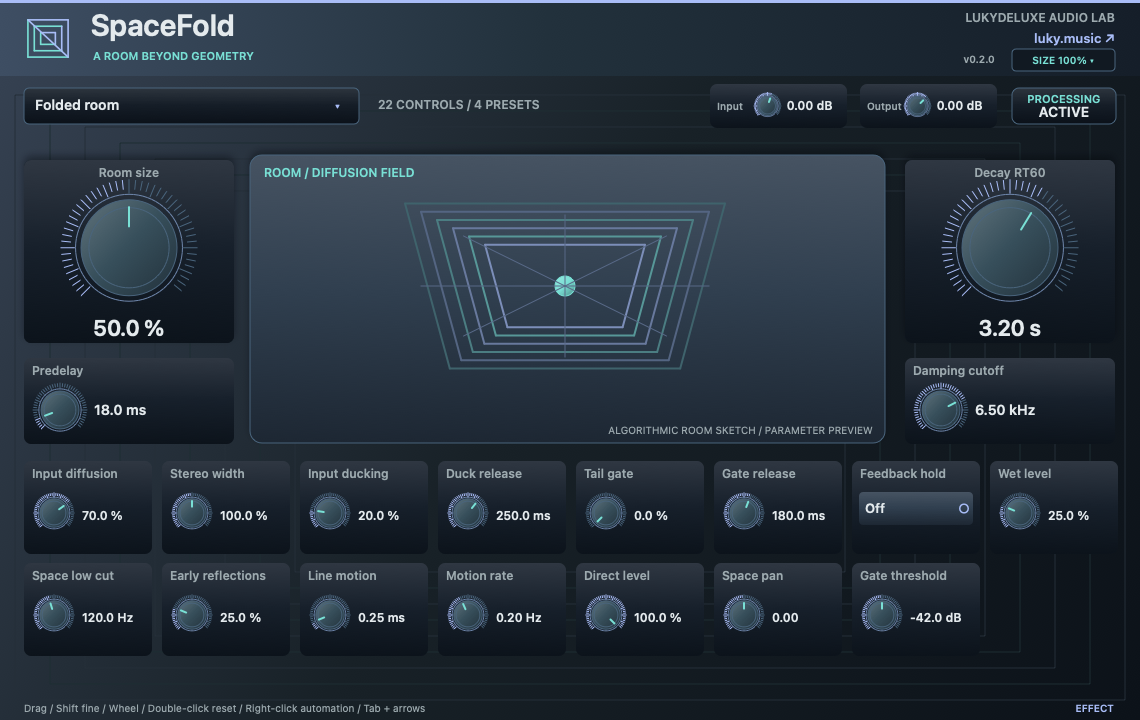
SpaceFold creates its own algorithmic space from four feedback delay lines. Room Size, Decay and Damping shape scale, length and high-frequency decay. Predelay and Early Reflections add another dimension to attack and distance, while Input Diffusion and gentle Line Motion change the reverb character. Explore short rooms through to long, moving layers.
Input Ducking reduces reverb during louder passages and lets it emerge afterwards. Tail Gate shortens or shapes the ending through Threshold and Release. Direct and Wet Level are independent; Stereo Width and Space Pan place the reverb in the stereo field. Feedback Hold can carry existing material for longer. Four presets offer room, vocal, gated and cloud starting points. A parametric room sketch sits between Size, Decay, Predelay and Damping. The overview presents all 22 parameters in a blue-violet composition with a portal mark and coordinated gradients. The sketch represents settings, not a measured room.
Features
- Four-line algorithmic reverb with Size, Decay RT60 and Damping
- 0–200 ms Predelay, early reflections and Input Diffusion
- Line Motion with independent modulation rate
- Input Ducking and Tail Gate with separate release controls
- Feedback Hold, Space Low Cut, Stereo Width and Space Pan
- Independent Direct/Wet levels and four factory presets
- A parametric room sketch sits between Size, Decay, Predelay and Damping. The overview presents all 22 parameters in a blue-violet composition with a portal mark and coordinated gradients. The sketch represents settings, not a measured room.
Ways to use it
- Vocal spaces that emerge between phrases
- Gated drum rooms and short effect accents
- Long modulated reverb clouds for pads and transitions
Try it
- Load SpaceFold as an insert or on a return; set Direct Level to 0 when using a return.
- Select a preset and adjust Room Size, Decay, Damping and Predelay.
- Set Early Reflections, Diffusion and Wet Level for the desired distance.
- Add Ducking or Tail Gate, then check width, Low Cut and Output in the mix.
Controls
22 parameters · room/decay · pre-delay · diffusion · stereo · ducking · freeze · wet
Compatibility and notes
SpaceFold is not a convolution reverb or a measured real-room recreation. Predelay is set freely in milliseconds. Feedback Hold remains affected by damping and saturation and is not an unchanged infinite loop. Project state contains parameters, not reverb tails or held audio. Early Access by LukyDeluxe Audio Lab, version 0.2.0 as VST3 for Windows x64 and macOS Universal (arm64/x86_64). The Mac edition is not notarized. No AU or standalone application. Broad DAW, GUI and long-session compatibility is still being developed. All sound parameters support DAW automation. Right-click opens the host-supplied parameter menu where the host supports this feature.
Windows x64 and macOS Universal (Apple Silicon/Intel). The Mac edition is not notarized. Intel runtime testing is not documented; follow the host and installation notes for the individual download.
All sound knobs, switches and selection parameters support host automation. Right-click a parameter to open its menu where your DAW provides one.
Install
- Choose the ZIP for your operating system and extract it.
- Windows: copy the entire .vst3 bundle to C:\Program Files\Common Files\VST3.
- macOS: extract the ZIP and open the product .pkg in the Installer folder. Install for your current user. The Mac edition is not notarized; follow the Mac installation and security guide on this page.
- Linux x86_64: copy the complete .vst3 bundle from Plugin to ~/.vst3/ (create the directory if needed). The editor uses X11 via Cairo/XCB and requires a VST3 host with IRunLoop; Wayland requires XWayland and a compatible host. Native Wayland and Linux ARM64 are not supported. Built on Ubuntu 22.04; exact library requirements are in INSTALL.txt in the Linux ZIP. Checked in native test hosts/Xvfb and pluginval; not yet tested in a Linux DAW. Not every Linux host or distribution has been tested.
- Rescan plugins in your 64-bit VST3 host. Load instruments on a MIDI track and effects in an audio insert.
Download details
- Windows x64 · VST3
- LukyDeluxe-spacefold-0.2.0-windows-x64-d883820a4238.zip
- ZIP size
- 0.34 MiB
- SHA-256
- d883820a4238867ba3ab31d9ecc18a3abe23517d0424e979c29134e09f7bbb3c
- macOS Universal · VST3
- LukyDeluxe-spacefold-0.2.0-macos-universal-c0cf64a03c55.zip
- ZIP size
- 0.18 MiB
- SHA-256
- c0cf64a03c551652c3cc1ba315380c1899565a750bd144f8a13940e1d501aecb
- Linux x86_64 · VST3
- LukyDeluxe-spacefold-0.2.0-linux-x86_64-599deee99381.zip
- ZIP size
- 0.13 MiB
- SHA-256
- 599deee9938171aebe23082d45d0175b0ec494f0acd1f6610fe9fc0cdff5eb2c
Mac installation, step by step
The Mac edition of SpaceFold is not notarized by Apple. Its ZIP contains an installer for this specific plugin. Load the installed VST3 in a 64-bit DAW that supports VST3; it is not a standalone app.
1. Extract the ZIP and open the installer
- Choose the macOS Universal ZIP. Quit your DAW and extract the complete ZIP in Finder.
- In the extracted Installer folder, open spacefold.pkg for SpaceFold. Do not launch the .vst3 as an app.
- If macOS blocks the installer because of an unidentified developer or missing Apple checks, follow section 2. Then reopen that same .pkg file.
- In Installer, choose installation for your current user account or home folder and finish the installation. The plugin destination is shown below.
- Restart your DAW, rescan its VST3 plugins and load SpaceFold there. Instruments use a MIDI track; effects use an audio insert.
Installation destination for your Mac user account
~/Library/Audio/Plug-Ins/VST3/
2. If macOS blocks the installer
Consider this exception only if you downloaded the file yourself from luky.music and trust that specific file. It applies to the product .pkg, not the .vst3 bundle.
- First try to open spacefold.pkg. Dismiss the unidentified-developer or missing-Apple-check alert, for example with Done; wording varies by macOS version.
- Open System Settings → Privacy & Security and scroll down to Security. Find the recently blocked entry with the actual filename of this product .pkg.
- If Open Anyway is offered for that exact installer, select it and confirm any further opening request. Approve any Mac password or Touch ID request yourself, only in the macOS system dialog.
- Reopen the same .pkg if Installer does not appear automatically. Install only for your current user. Then restart the DAW and rescan the plugin.
No matching entry, or a different warning?
If the entry for the recently blocked .pkg remains absent, contact our support or your IT administrator on a managed Mac. If approving the .vst3 bundle only opens Finder and the DAW remains blocked, the plugin has not been successfully approved; use the product installer. Do not use this procedure to dismiss warnings about malware or a damaged or modified file: stop installation and investigate. Filenames and checksums are listed under Download details.
Keep Gatekeeper enabled. This guide requires neither Terminal commands to remove quarantine nor blanket approval for other software.
Apple’s guidance for safely opening downloaded software ↗